Published on Jul 16, 2026
Cryogenic RF Amplifier: Technology, Specifications & Applications
A radio signal from a rover on Mars, millions of kilometers away, arrives at Earth measured in attowatts. That’s the ordinary operating condition for deep space and radio astronomy work. A standard low noise amplifier, however good, adds enough of its own thermal noise to bury a signal that faint before it reaches the receiver electronics. Cooling the amplifier to 4 K suppresses that thermal noise.
That’s the whole premise of a cryogenic RF amplifier: take a low noise amplifier design that already works, and get it to keep working at a few kelvin above absolute zero.
The Manufacturing Problem Behind a 4 K Spec
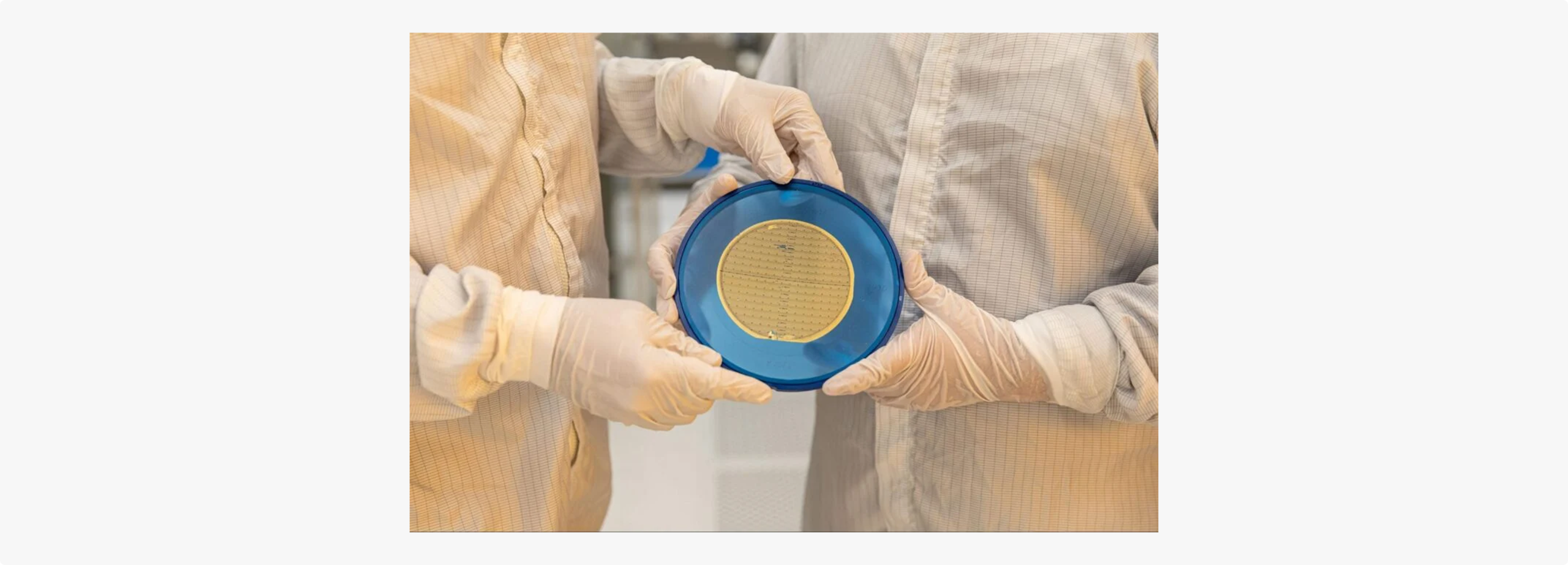
InP HEMTs hold their electron mobility at cryogenic temperature. That’s why Low Noise Factory builds the LNC series on that process instead of silicon. LNF fabricates its InP HEMTs in roughly 20 process steps using electron-beam and laser lithography, with gate lengths under 50 nm and precision measured in single atomic layers. Sample units from every batch get cycled to 4 K and back 100 times before a design ships, because a system in the field goes through that same cooldown cycle every time it comes back up from scheduled maintenance. That repeatability is what the qualification process buys.
For a plainer introduction to the category, see our earlier piece, What are Cryogenic Low Noise Amplifiers?
Power Budget Inside the Cryostat
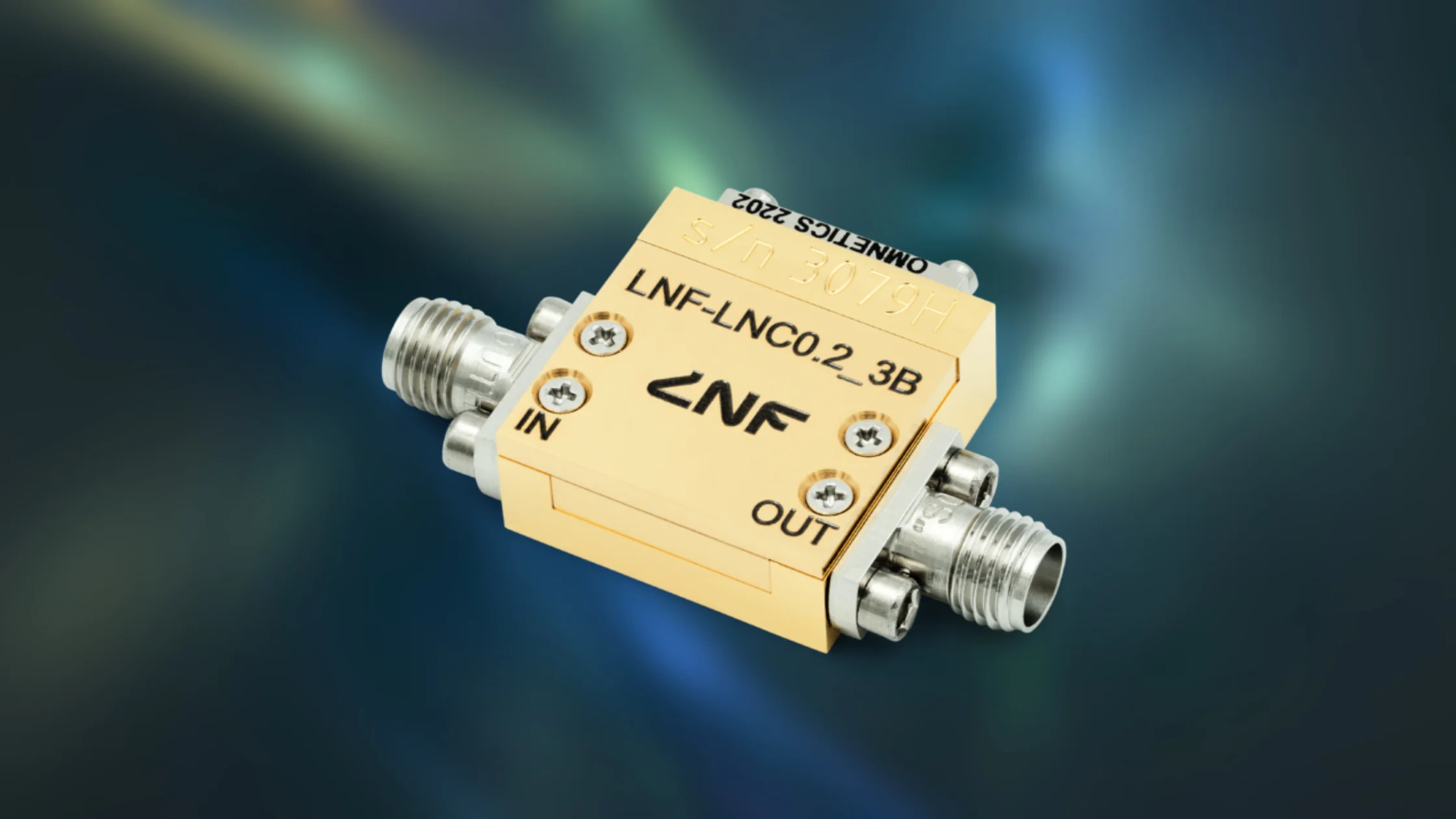
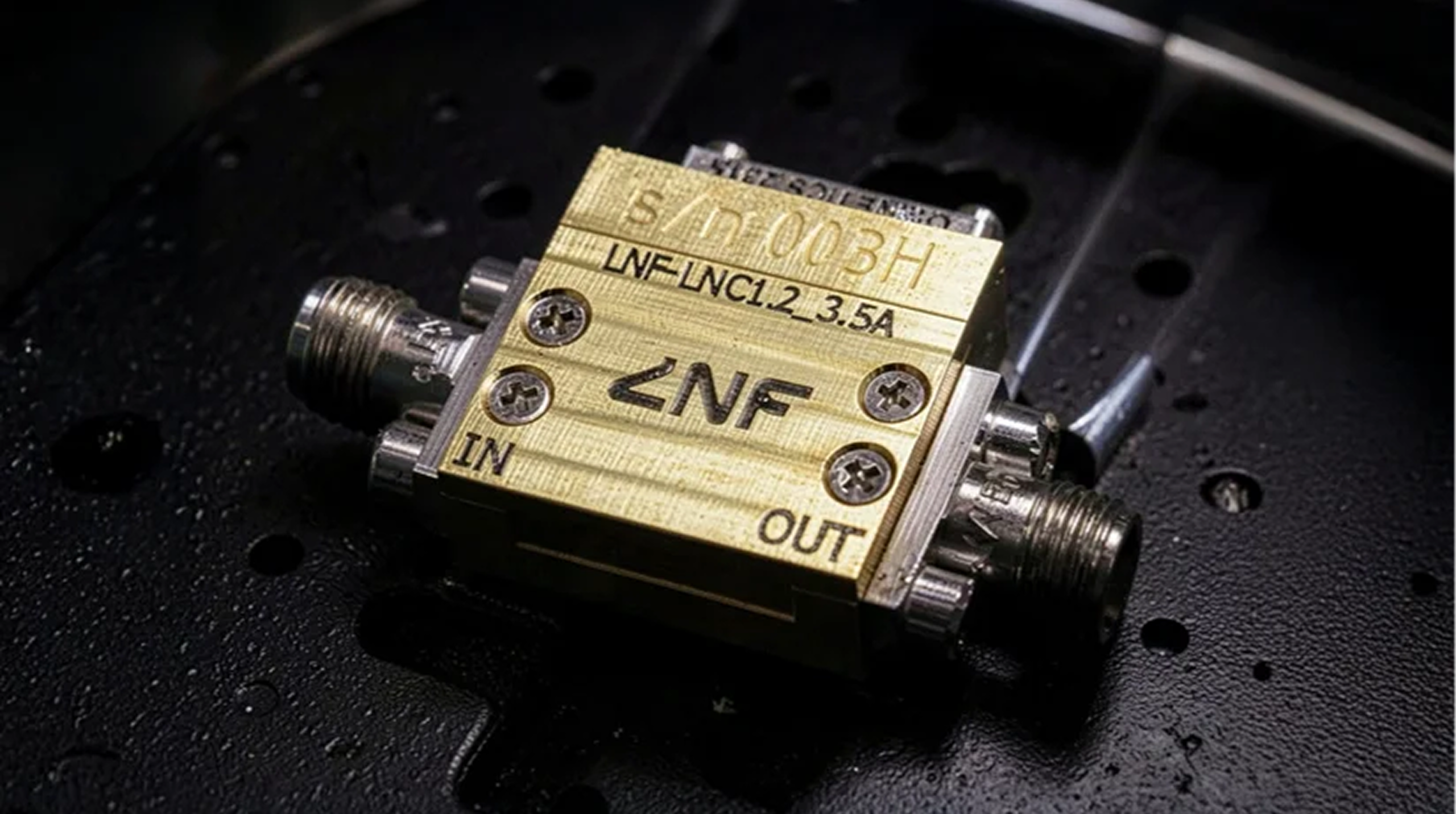
Most modern cryo-LNAs, including the LNC series, are MMIC cryogenic amplifiers: monolithic microwave integrated circuits with several cascaded gain stages on a single InP chip instead of discrete transistors wired together. Inside a cryostat, that buys more than unit-to-unit consistency. A single die reaches base temperature faster than a multi-component circuit, and it draws less power doing it.
Power dissipation is a hidden constraint here. A cryocooler’s 4 K stage typically has a cooling budget in the single-digit milliwatts, and every amplifier, isolator, and cable run in the chain draws against it. Large multi-antenna arrays and multi-dish deep space complexes run dozens of receiver chains off that same limited budget. Add one more chain, and the amplifier’s own power draw starts competing directly with the cryocooler’s finite capacity.
Beyond the LNA: The Rest of the Cold Chain
A cryogenic isolator or circulator typically sits ahead of the LNA in a receiver chain, protecting the amplifier from reflections and keeping the impedance match back to the antenna or detector clean. A room-temperature amplifier follows, ahead of digitization. LNF builds both ends of that chain: cryogenic isolators and circulators from 4 to 12 GHz with insertion loss as low as 0.17 dB, in single, dual, and triple-junction configurations, with gold-plated OFHC copper bodies to keep loss, and the thermal noise that loss adds, as close to zero as the physics allows. Sourcing the isolator, LNA, and post-amp from one vendor removes a common integration risk: mismatched interfaces between components qualified by different manufacturers under different test conditions.
Applications: Where This Has Already Been Used
Two domains account for most of where this technology actually gets deployed: radio astronomy and deep space communication. A few examples.
SETI Institute’s Allen Telescope Array.
One of LNF’s first large orders came from the SETI Institute: hundreds of amplifiers for an expanded array of radio antennas, developed with Caltech and installed as the Allen Telescope Array began operating in 2007. It’s a useful data point for anyone wondering whether a specialist manufacturer can support an order at real observatory scale. Nearly two decades on, the answer is yes.
ESA’s Juice mission to Jupiter.
In 2017, LNF delivered Ka-band cryogenic LNAs to the European Space Agency for next-generation deep space communication. That relationship continued into ESA’s Jupiter Icy Moons Explorer (Juice), launched in 2023, which carries LNF’s MMICs integrated into its receiver by Omnisys Instruments. Juice is still years into its cruise to the Jupiter system, running on an amplifier chip that was qualified long before launch and can’t be serviced once it left Earth.
Voyager 1’s interstellar link.
NASA’s Deep Space Network still receives telemetry from Voyager 1, the most distant human-made object from Earth, through cryogenically cooled InP HEMT amplifiers at its 70-metre dishes. JPL’s engineering data records LNA modules reaching noise temperatures as low as 3.5 K at 8.5 GHz and 8.5 K at 32 GHz. That margin is what keeps a decades-old, low-power transmitter intelligible across interstellar distance.
New Horizons’ Pluto flyby.
In July 2015, New Horizons flew past Pluto roughly 4.8 billion kilometers from Earth and began sending back what it saw. At closest approach, the DSN’s cryogenically cooled receivers were pulling in telemetry at just 1 to 4 kilobits per second. The full 6.25 gigabytes gathered during the nine-day encounter took more than a year to download at that rate. That’s the kind of link budget where a fraction of a kelvin in the amplifier’s noise temperature is the difference between a mission returning data and returning nothing.
Cryo-LNA vs Room-Temperature LNA
LNF’s room-temperature InP HEMT amplifiers (4 to 115 GHz) run around 32 K noise temperature. The same transistor technology, cooled to 4 K in the LNC series, reaches as low as 1.1 K: roughly a 30x cut in the amplifier’s own noise contribution. Cryo-LNAs ship in slim, non-hermetic coaxial modules built to operate in vacuum.
Noise Temperature vs Noise Figure
Room-temperature engineers spec in noise figure, in dB, referenced to 290 K. Cryo datasheets spec in noise temperature instead: Te = T0(10^(NF/10) minus 1), where T0 = 290 K. It holds precision at the low end. Below a few kelvin, a fraction of a decibel in noise figure is the difference between resolving a faint signal and losing it under the noise floor.
Why Partner with Globetek
Handling matters as much as the spec sheet. InP HEMTs are sensitive to bias sequencing, gate before drain on power-up, and to ESD. A wrong sequence or a static discharge destroys the part, and replacement means weeks of lead time. Globetek has represented Low Noise Factory in India for years, supporting procurement through installation and after-sales calibration. For a component this sensitive to handling and cooldown procedure, a local partner who understands the cryogenic RF ecosystem is often what determines whether a receiver chain performs to spec on the first attempt.
For more on how this space is developing in India specifically, see Low-Noise Amplifiers (LNAs) and the Rise of Cryogenic Technology in India.
FAQs
What’s the difference between a cryogenic LNA and a cryogenic RF amplifier?
The terms are used interchangeably. “LNA” emphasizes the low-noise design goal; “cryogenic RF amplifier” is the broader technical category.
Can a cryo-LNA run at room temperature?
It stays electrically functional but won’t hit its rated noise temperature. The InP HEMT needs the cryogenic environment to reach its lowest-noise operating point.
What temperature do cryo-LNAs typically operate at?
Most are specified and tested at 4 K, matching the cold stage of a standard dilution refrigerator or cryostat. If you’re specifying a cryo-LNA for a radio telescope front end or deep space ground station, reach out to Globetek: we’ll help match the noise temperature and frequency band to your system, and support the install through to commissioning.
References
- NASA JPL DESCANSO, Low-Noise Systems in the Deep Space Network (M. S. Reid, ed.): https://descanso.jpl.nasa.gov/monograph/series10/Reid_DESCANSO_sml-110804.pdf
- Low Noise Factory, “The InP HEMT”: https://lownoisefactory.com/inphemt/
- Low Noise Factory, “About” (company timeline, SETI/ATA and ESA Juice history): https://lownoisefactory.com/about/
- NASA, “New Horizons Spacecraft Begins Intensive Data Downlink Phase”: https://www.nasa.gov/general/nasas-new-horizons-spacecraft-begins-intensive-data-downlink-phase/
Read More