Published on Jul 25, 2026
AC Current Sensor: How It Works, CT vs Rogowski vs Hall Effect
Electrical systems depend on accurate current measurement for protection, control, and energy management. Whether you’re designing an EV charger, monitoring an industrial motor, or installing an energy meter, the first step is choosing the right sensing technology.
Three sensor types dominate AC current measurement:
- Current Transformers (CTs)
- Rogowski Coils
- Hall Effect Sensors
Although all three measure current, they operate differently and are designed for different applications. Understanding those differences helps engineers balance accuracy, bandwidth, installation, and cost.
What is an AC Current Sensor?
An AC current sensor measures alternating current without making electrical contact with the conductor.
Instead of carrying the current itself, the sensor detects the magnetic field produced by the conductor and converts it into an electrical signal for monitoring or control.
AC current sensors are commonly used in:
- Energy metering
- Industrial automation
- HVAC systems
- Motor drives
- Power quality monitoring
- EV charging infrastructure
For a broader understanding, read: What is a Current Sensor?
Why Current Measurement Matters
Current is one of the most useful indicators of how an electrical system is performing.
A motor drawing more current than expected may indicate excessive mechanical load. A gradual increase in current can point to bearing wear or insulation problems. In power distribution systems, abnormal current often provides the earliest warning of overloads or faults.
Without current sensing, these conditions remain invisible until equipment performance degrades or a failure occurs.
How AC Current Sensing Works
Whenever alternating current flows through a conductor, it creates a magnetic field that expands and collapses as the current changes direction.
An AC current sensor detects this changing magnetic field and converts it into a proportional electrical signal. That signal is then processed by meters, PLCs, protection relays, or control systems.
Unlike voltage measurement, current sensing usually does not require a direct electrical connection to the conductor. This improves safety while providing galvanic isolation between the power circuit and the measurement electronics.
The operating principle is based on electromagnetic theory and is described in standard references such as Electrical Measurement, Signal Processing, and Displays by John G. Webster.
The Evolution of AC Current Sensors
Current sensing technologies were developed to solve different engineering challenges rather than replace one another.
Current Transformers (CTs)
Current transformers appeared alongside the growth of electrical power systems in the late nineteenth century. They made it possible to measure high AC currents safely by using electromagnetic induction.
Today they remain the most widely used current sensors in switchgear, protection systems, and energy meters.
Rogowski Coils
Traditional current transformers perform well, but their magnetic cores can saturate under very high currents.
The Rogowski coil was developed to overcome this limitation. Its air-core construction eliminates magnetic saturation while providing excellent bandwidth and flexibility.
These characteristics make Rogowski coils well suited for high-current measurement and power quality analysis.
Hall Effect Sensors
Hall effect sensors measure magnetic field strength directly instead of relying on electromagnetic induction.
Because of this, they can measure both AC and DC current, making them the preferred choice for battery systems, motor drives, renewable energy systems, and electric vehicles.
Although discovered by Edwin Hall in 1879, Hall-effect technology became widely adopted only after advances in semiconductor manufacturing made compact, accurate sensors practical.
Types of AC Current Sensors
Each sensing technology has its own strengths and limitations.
The right choice depends on factors such as:
- Current range
- Measurement accuracy
- Frequency response
- Installation method
- Available space
- Whether DC measurement is required
The three most common technologies are discussed below.
Current Transformer (CT)
A current transformer uses electromagnetic induction to generate an output proportional to the AC current flowing through a conductor.
Operating Principle

As current passes through the primary conductor, it creates a changing magnetic field. This induces a proportional current in the transformer’s secondary winding, which is converted into a measurable voltage using a burden resistor.
Typical circuit:
AC Line ────[Load]───────┐
│
┌─────┐
│ CT │
└─────┘
││
[Burden Resistor]
│
Output Voltage
Typical Applications
- Energy metering
- Electrical panels
- HVAC equipment
- Protective relays
- Industrial automation
Advantages
- High accuracy
- Excellent isolation
- Low cost
- Long service life
- Available in solid-core and split-core versions
Limitations
- Measures AC only
- Magnetic core can saturate
- Secondary circuit must never be left open while energized
Rogowski Coil
A Rogowski coil measures current using an air-core winding placed around the conductor.
Because there is no magnetic core, the sensor does not saturate, even under extremely high current conditions.
Operating Principle

Since the coil measures the rate of change of current, an electronic integrator converts the output into a signal proportional to the actual current.
Signal Path
Conductor → Rogowski Coil → Integrator → Output
Typical Applications
- High-current busbars
- Grid monitoring
- Power quality analyzers
- Generator testing
- Large industrial installations
Advantages
- No magnetic saturation
- Very wide bandwidth
- Lightweight construction
- Flexible installation
- Suitable for very large conductors
Limitations
- Measures AC only
- Requires an integrator circuit
- Generally more expensive than standard CTs
Hall Effect Sensor (AC + DC)
Hall effect sensors measure the magnetic field surrounding a conductor rather than relying on electromagnetic induction.
This allows them to measure both alternating and direct current with a single device.
Operating Principle

Typical Applications
- EV chargers
- Battery energy storage systems
- Motor drives
- Solar inverters
- Power supplies
- UPS systems
Advantages
- Measures both AC and DC
- Fast response
- Good electrical isolation
- Compact design
- Easy integration into electronic systems
Limitations
- Higher cost than CTs
- Accuracy depends on temperature compensation and sensor design
- Typically lower bandwidth than Rogowski coils
Manufacturers such as Texas Instruments and Analog Devices publish detailed application notes covering Hall-effect sensor design, calibration, and implementation.
Current Transformer vs Rogowski Coil vs Hall Effect
Choosing the right current sensor depends on more than whether it measures AC or DC. Accuracy, frequency range, installation, current level, and cost all influence the best choice.
| Feature | Current Transformer(CT) | Rogowski Coil | Hall Effect Sensor |
| AC Measurement | Excellent | Excellent | Good |
| DC Measurement | No | No | Yes |
| Magnetic Saturation | Possible | None | None |
| Accuracy | High | High | Moderate to High |
| Frequency Range | Limited | Very Wide | Moderate |
| Installation | Fixed or Split-core | Flexible Coil | PCB or Module |
| Cost | Low to Medium | Medium | Medium to High |
When Should You Choose Each Sensor?
No single technology is the best in every situation.
Choose a Current Transformer (CT when:)
- Only AC current needs to be measured.
- Cost is an important factor.
- High accuracy is required for metering or protection.
- Installation space is limited.
Choose a Rogowski Coil when:
- Current levels are very high.
- Conductors are too large for conventional CTs.
- Wide bandwidth is required.
- Flexibility simplifies installation.
Choose a Hall Effect Sensor when:
- Both AC and DC currents must be measured.
- The application involves batteries or power electronics.
- Electrical isolation is required.
- Fast current feedback improves system performance.
What Makes a Sensor Suitable for AC Measurement?
Alternating current continuously changes direction. As the current changes, the magnetic field around the conductor also changes.
Current transformers and Rogowski coils rely on this changing magnetic field to generate an output. If the current remains constant, as with DC, they produce no usable signal.
Hall effect sensors work differently. They measure magnetic field strength directly, allowing them to detect both changing and constant magnetic fields. That is why Hall effect sensors can measure both AC and DC current.
Applications of AC Current Sensors
Different industries use different sensing technologies because their measurement requirements vary.
Energy Monitoring
Energy meters rely on accurate current measurement to calculate power consumption, monitor loads, and support billing.
Current transformers remain the preferred choice because they combine high accuracy, long service life, and competitive cost.
Typical applications include:
- Smart meters
- Building energy management
- Industrial energy monitoring
- Sub-metering
Motor Drives
Modern motor drives continuously monitor current to regulate torque, improve efficiency, and detect overload conditions before equipment is damaged.
Hall effect sensors are widely used because they respond quickly and measure both AC and DC currents.
Typical applications include:
- Variable Frequency Drives (VFDs)
- Servo drives
- Industrial automation
- Robotics
HVAC Equipment
Compressors, pumps, and fan motors all benefit from continuous current monitoring.
Abnormal current often provides an early indication of worn bearings, blocked filters, overloaded motors, or electrical faults.
Split-core current transformers are especially useful because they can be installed without disconnecting existing wiring.
Typical applications include:
- Air handling units
- Chillers
- Compressors
- Building management systems
Grid Monitoring
Utilities monitor current throughout transmission and distribution networks to detect faults, balance loads, and maintain power quality.
Rogowski coils are commonly selected for these applications because they handle high currents without magnetic saturation and fit easily around large conductors.
Typical applications include:
- Distribution substations
- Feeder monitoring
- Transformer monitoring
- Power quality analysis
EV Charging Systems
Electric vehicle chargers measure both AC input current and DC charging current.
Hall effect sensors are commonly used because a single sensor can measure both while providing electrical isolation from the power circuit.
Typical applications include:
- AC chargers
- DC fast chargers
- Battery management systems
- Energy storage equipment
Recommended LEM Current Sensors by Application
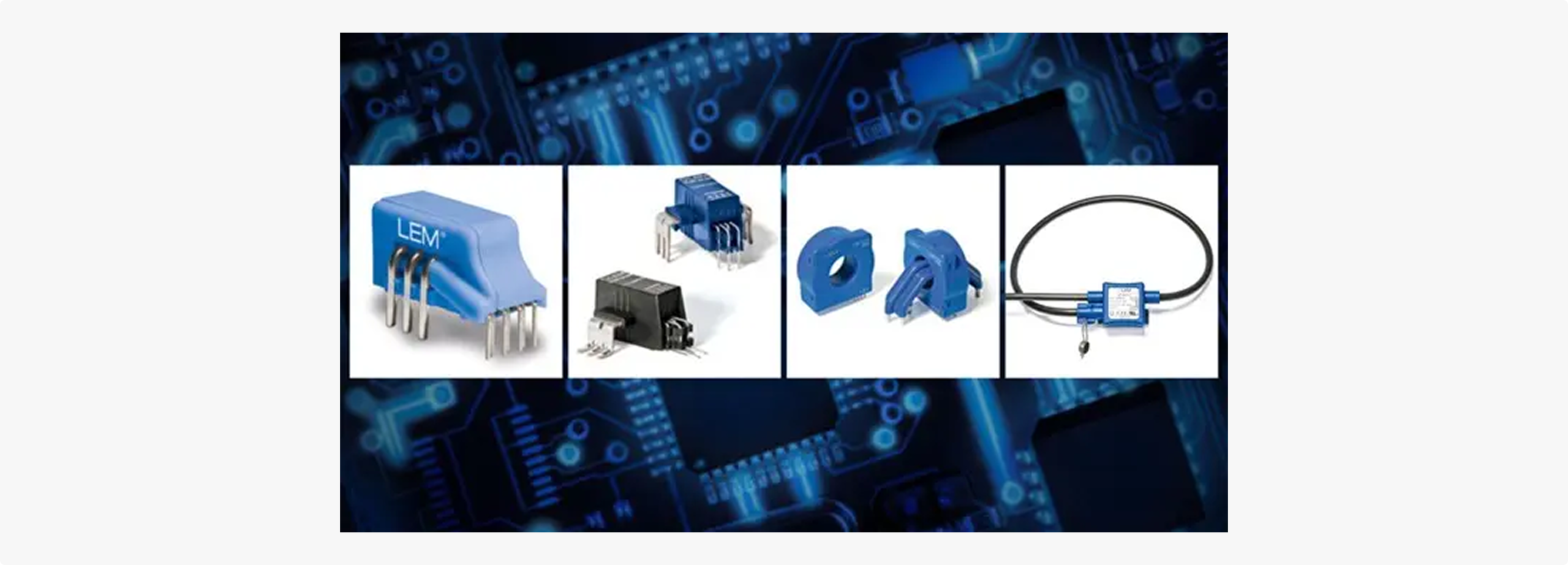
Selecting the right sensing technology is only the first step. The sensor must also match the application’s accuracy, operating environment, current range, and installation requirements.
Globetek has supplied LEM current sensors for more than three decades, supporting customers across industrial automation, renewable energy, transportation, and power electronics.
Below are several LEM product families commonly used in these applications.
Energy Monitoring and HVAC
LEM CTSR Series (Closed-Loop Fluxgate Current Transducers)
The CTSR Series is designed for applications where measurement accuracy and long-term stability are priorities.
Typical applications include:
- Energy monitoring
- Leakage current detection
- Residual current measurement
- Power system protection
- Photovoltaic inverters
These sensors are well suited to systems where accurate current measurement affects both performance and safety.
Industrial Motor Control
LEM HLSR Series (Open-Loop Hall Effect Sensors)
The HLSR Series is intended for power electronics that experience rapid current changes.
Typical applications include:
- AC variable-speed drives
- Servo drives
- DC motor controllers
- UPS systems
- Switched-mode power supplies
- Welding equipment
- Solar inverters
- Battery-powered equipment
The combination of fast response and compact size makes this series suitable for many industrial control systems.
EV Chargers and Power Electronics
LEM HO Series (Closed-Loop Hall Effect Sensors)
The HO Series provides stable current measurement with low offset drift, making it suitable for demanding power conversion applications.
Typical applications include:
- EV charging stations
- Battery energy storage systems
- AC and servo drives
- DC motor drives
- UPS systems
- Switched-mode power supplies
- Solar inverters
- DC/DC converters
Because these sensors measure both AC and DC current, they are widely used wherever accurate feedback is needed for control and protection.
High Current Grid Monitoring
LEM ART Series (Rogowski Coil Solutions)
The ART Series is designed for high-current AC measurement where conventional current transformers become difficult to install.
Typical applications include:
- Distribution substations
- Transformer monitoring
- Phasor Measurement Units (PMUs)
- Commercial buildings
- Industrial facilities
- Energy metering
- Demand response systems
- Distribution network monitoring
Their flexible construction allows installation around large conductors without modifying existing equipment.
Explore the full range of LEM Current Sensors available through Globetek to identify the most suitable solution for your application.
Why Source LEM Current Sensors Through Globetek?
Choosing a current sensor doesn’t end with comparing specifications. Product availability, technical support, and application guidance are just as important, especially for industrial projects where downtime and redesigns are expensive.
As an authorized LEM partner, Globetek supplies genuine current sensing solutions backed by local engineering support. Whether you’re selecting a sensor for a new design or replacing an existing component, our team can help identify the right product for your application.
Working with Globetek gives you access to:
- Genuine LEM current sensors
- Local technical support
- Product selection guidance
- Reliable sourcing and logistics
- Assistance with integration and replacement
Explore our complete range of LEM Current Sensors to find products for industrial automation, energy management, EV charging, and power electronics.
Technical Selection Checklist
Before selecting an AC current sensor, answer these questions:
What current range needs to be measured?
The sensor should cover both normal operating current and any expected overload conditions.
Is AC measurement enough, or is DC measurement also required?
Current transformers and Rogowski coils measure AC only. Hall effect sensors measure both AC and DC.
What level of accuracy is needed?
Revenue metering, protection systems, and laboratory equipment typically require higher accuracy than general monitoring applications.
What frequency range must be measured?
Power quality analysis often requires a wider bandwidth than standard energy metering.
What isolation level is required?
The sensor should provide sufficient electrical isolation between the power circuit and measurement electronics.
Which output type is needed?
Depending on the system, the output may be:
- Analog voltage
- Analog current
- Digital interface
- Bus communication
How will the sensor be installed?
Consider:
- Available space
- Split-core or solid-core construction
- PCB mounting
- Busbar mounting
- Cable routing
What are the operating conditions?
Temperature, humidity, vibration, dust, and electrical noise all influence sensor selection and long-term performance.
Answering these questions early makes it much easier to narrow the choice between a CT, Rogowski coil, or Hall effect sensor.
Frequently Asked Questions
Do current sensors use AC or DC?
Current sensors measure electrical current. Some technologies, such as current transformers and Rogowski coils, measure AC only. Hall effect sensors measure both AC and DC current.
Can a Hall effect sensor measure AC current?
Yes. Hall effect sensors measure magnetic field strength, allowing them to detect both alternating and direct current.
What is a Current Transformer (CT?)
A current transformer is an AC current sensor that uses electromagnetic induction to produce an output proportional to the current flowing through a conductor. It is commonly used in: Energy metering, Protection systems, Industrial control panels and HVAC equipment.
What is a Rogowski coil used for?
A Rogowski coil measures high AC currents without using a magnetic core. Its wide bandwidth and flexible construction make it suitable for: Power quality analysis, Grid monitoring, High-current busbars and Large industrial installations
Which current sensor is best?
The answer depends on the application. Current Transformer CT: Best for accurate, cost-effective AC measurement. Rogowski Coil: Best for very high currents and wide bandwidth. Hall Effect Sensor: Best when both AC and DC current must be measured. Each technology solves a different measurement problem.
Conclusion
AC current sensors are a fundamental part of modern electrical systems. They provide the information needed to measure energy, protect equipment, monitor system health, and control power electronics.
The right sensor depends on the application.
- Choose a Current Transformer (CT) for accurate, economical AC measurement.
- Choose a Rogowski Coil for high-current systems that require wide bandwidth and freedom from magnetic saturation.
- Choose a Hall Effect Sensor when the application requires both AC and DC current measurement.
After selecting the sensing technology, choosing the right product family becomes much simpler. LEM offers current sensing solutions for industrial automation, renewable energy, transportation, and power electronics, while Globetek provides local product availability and engineering support to help move projects from design to deployment.
References
- IEEE Standards on Current Measurement
- John G. Webster, Electrical Measurement, Signal Processing, and Displays
- National Institute of Standards and Technology (NIST)
- LEM Technical Documentation and Application Notes
- Texas Instruments Application Notes
- Analog Devices Technical Resources
Read More