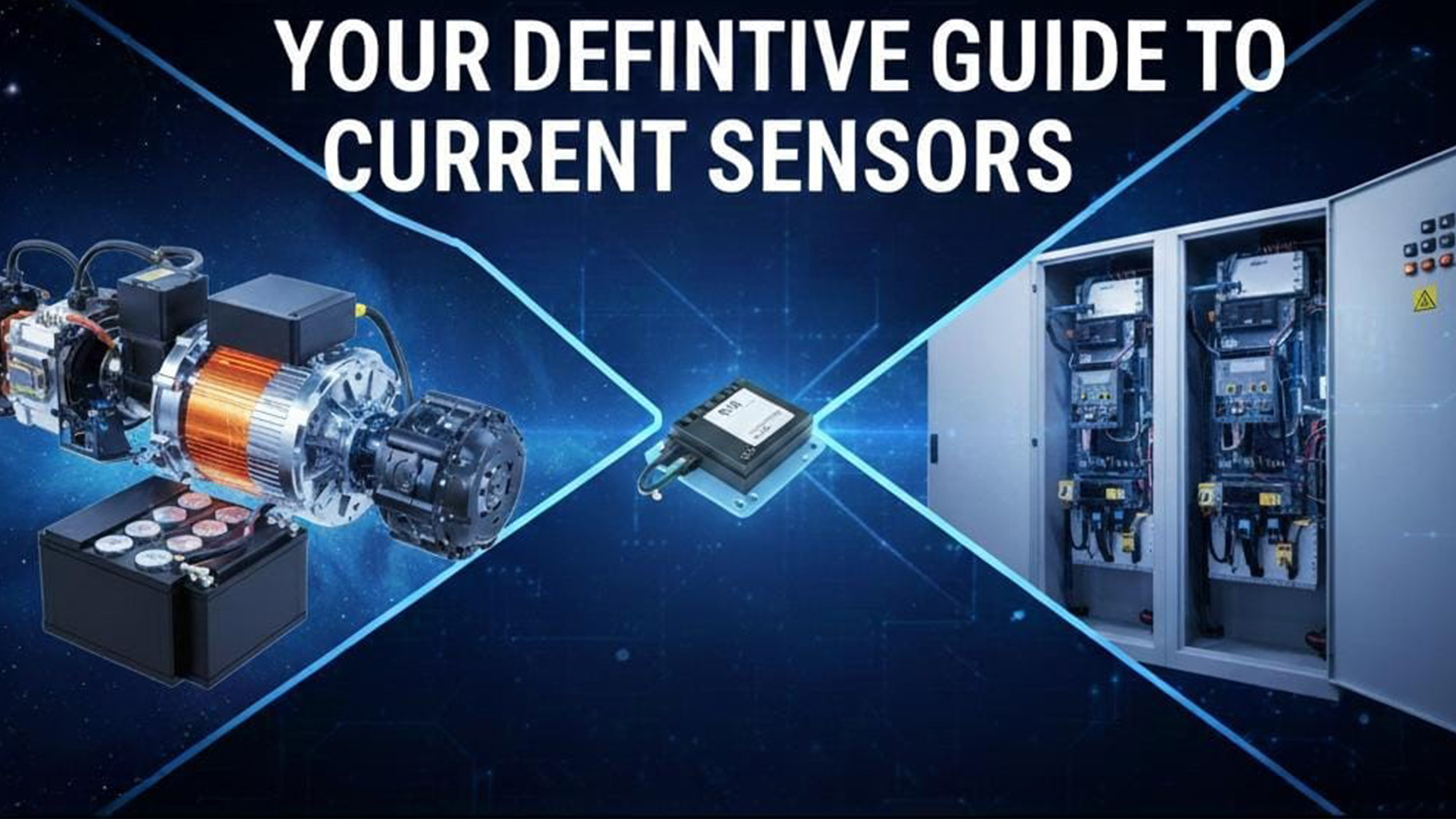
The one component common across industrial automation, electric mobility, and renewable energy, which keeps systems safe and efficient is the current sensor.
In simple terms, it’s like a speedometer for electricity. Just like a speedometer tells you how fast a car goes, a current sensor tells you how much current is flowing in a wire.
However, it’s obviously more complex than the above explanation. So, in this guide, we will break down what current sensors are, the specific technologies behind LEM’s renowned accuracy, and how these devices are transforming industries today.
What Are Current Sensors?
At its core, a current sensor (often referred to as a current transducer) detects the flow of electric current in a wire or busbar and generates a signal proportional to that current. This output signal—typically a voltage or a lower current—can then be read by a control system, such as a PLC, microcontroller, or Battery Management System (BMS).
While the concept sounds simple, the execution is complex. A high-quality sensor must measure current without interrupting the circuit (non-intrusive) and often needs to provide galvanic isolation.
This means the high-voltage primary circuit is electrically separated from the low-voltage control side, protecting delicate electronics (and human operators) from dangerous potential differences.
LEM sensors distinguish themselves by offering solutions for measuring AC, DC, and pulsed currents, providing a real-time picture of electrical health.
The Technologies Behind the Measurement
LEM has developed a variety of technologies to suit different needs, ranging from cost-effective monitoring to ultra-high precision lab equipment. Here are the primary technologies you will find in the catalog at Globetek:
1. Hall Effect Technology
This is the most common technology used in industrial and automotive sensing. It relies on the Hall Effect principle, where a magnetic field generated by the current creates a voltage difference across a semiconductor material.
Open Loop Hall Effect: In these sensors, the magnetic field from the primary current is concentrated by a magnetic core and measured directly by a Hall cell. They are compact, lightweight, and cost-effective. They are ideal for applications where low power consumption and small size are critical, but extreme accuracy is secondary.
Closed Loop Hall Effect: These are the “precision” workhorses. They use a secondary winding to generate a magnetic field that opposes the primary field, effectively canceling it out (zero flux). The current required to zero the flux is the output signal. This method offers excellent linearity, fast response times, and wide bandwidth, making them superior for demanding drive and inverter applications.
2. Fluxgate Technology
For applications requiring extreme accuracy and low offset drift, LEM employs Fluxgate technology.
Principle: Instead of a simple Hall cell, Fluxgate sensors use a saturable magnetic inductor (a “gate”) to detect the magnetic field.
Performance: These sensors offer exceptional stability over temperature and time. They effectively eliminate the offset inherent in Hall sensors. You will often see these used in medical equipment (like MRI power supplies) and high-end test equipment. LEM’s CAB series, for instance, utilizes Fluxgate technology for precise battery monitoring in EVs.
3. Integrated Current Sensors (ICS)
As electronics shrink, so must the sensors. LEM’s ICS technology eliminates the traditional magnetic core entirely. Instead, they use a specialized chip with multiple Hall elements capable of sensing the magnetic field directly from the current flowing through the package or a PCB track. These are perfect for space-constrained applications like solar string optimizers and server power supplies.
Types of Sensors Available
When browsing our LEM inventory at Globetek, you will typically encounter these classifications based on configuration and use-case:
The “Loop” Classifications
Open Loop Transducers: These provide a voltage output. They are generally smaller and lighter. (Example: HAS Series).
Closed Loop Transducers: These provide a current output (typically) and offer higher immunity to electrical noise. (Example: CTSR Series).
Application-Specific Types
PCB Mount Sensors: Small footprint sensors designed to be soldered directly onto printed circuit boards. Used heavily in power supplies and small motor drives.
Busbar / Aperture Sensors: These have a large hole (aperture) through which a heavy cable or busbar passes. They are designed for high-power industrial and railway traction applications.
Automotive Grade: Specialized sensors like the HAH and CAB families, designed to withstand the harsh vibration and temperature environments of vehicles while meeting safety standards like ISO 26262.
Key Applications and How They Are Used
Current sensors are the eyes of the power system. Without them, control systems are blind to how much energy is being consumed or generated.
Here is how industries are using LEM sensors today:
1. Automotive & E-Mobility
Battery Management Systems (BMS): This is arguably the most critical application. A sensor (often a high-precision Fluxgate type) sits on the battery terminal to measure exactly how much charge goes in (during charging/regenerative braking) and how much goes out (acceleration). This data calculates the State of Charge (SoC) and State of Health (SoH), determining the car’s range.
Motor Inverters: To turn the wheels smoothly, the inverter needs to know exactly how much current is going into the electric motor phases. High-speed sensors provide feedback to the inverter logic to control torque and speed instantly.
2. Industrial Automation & Drives
In factories, variable speed drives (VSDs) control electric motors for pumps, fans, and conveyors.
Torque Control: Since torque is directly proportional to current, sensors allow the drive to maintain constant torque even as the load changes.
Protection: If a conveyor jams, the current spikes immediately. The sensor detects this overload in microseconds and signals the controller to cut power, saving the motor from burning out.
3. Renewable Energy
Solar Inverters: Solar panels produce DC, which must be converted to AC for the grid. Sensors on the DC side ensure the panels are operating at their Maximum Power Point (MPPT), while sensors on the AC side ensure the power fed to the grid is synchronized and clean.
Wind Turbines: Huge sensors measure the power output of the generator and monitor the condition of power converters located up in the nacelle.
4. Power Supplies (UPS & SMPS)
Data centers rely on Uninterruptible Power Supplies (UPS). Current sensors monitor the battery banks to ensure they are ready to take over instantly during a blackout. They also regulate the charging process to prevent battery damage.
Our Partnership with LEM
At Globetek, we sell LEM sensors because they represent the “install and forget” reliability that our customers need.
Whether it is the galvanic isolation that ensures safety up to thousands of volts, or the wide frequency bandwidth that captures complex waveforms in modern switching power supplies, LEM technology is unmatched.
Oh, also, we happen to be their partner for over three decades. Their quality, accessibility, and reliability is unmatched.
If we had to list it down, it comes down to:
Safety: Complete isolation between high-power and control circuits.
Versatility: Ability to measure DC, AC, and complex pulsed currents with a single device.
Accuracy: From standard 1% accuracy industrial units to 0.1% high-precision lab units.
Reliability: 5-year warranties are common, reflecting the durability of these components.
So, if we were to come back to the question of What are Current sensors – they’re simply enablers of energy efficiency and system intelligence.
Whether you are building a new EV charger, a robotic arm, or a smart grid monitor, Globetek has the LEM sensor to fit your specification. Browse our catalog today to find the right sensing technology for your next project.