
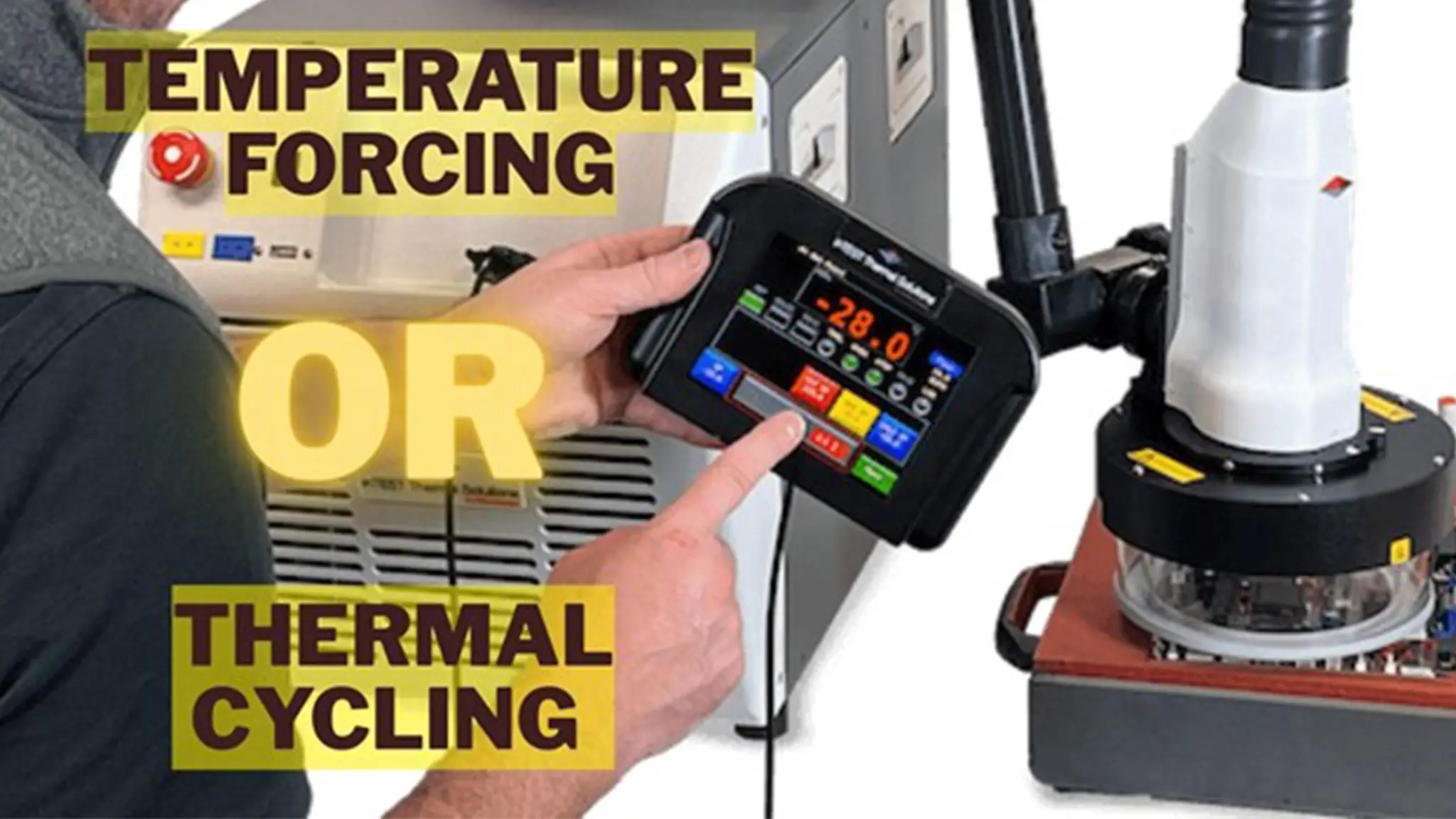
When electronic components fail in the field, it’s almost always due to repeated exposure to temperature changes. The temperature change has a cascading effect on the strength of materials, solder joints, packaging, or design. This is why thermal testing is so important for reliability in semiconductor and electronics manufacturing.
Two terms often come up in this context: thermal cycling and temperature forcing systems. While they are sometimes used interchangeably, they serve very different purposes. Understanding the difference helps us pick the right test approach for semiconductor validation, automotive electronics, or high-reliability applications.
This article breaks down how thermal cycling systems differ from temperature forcing systems, where each fits best.
What Is Thermal Cycling?
Thermal cycling is a batch-based environmental test where devices are placed inside a chamber and exposed to alternating high and low temperatures over extended periods.
How thermal cycling works
- Devices are loaded into a thermal chamber
- The entire chamber ramps up to a high temperature
- It then ramps down to a low temperature
Thermal cycling is widely used for:
- Long-term reliability testing
- Qualification testing
- Stress screening of electronic assemblies
- Identifying fatigue-related failures
Strengths of thermal cycling
- Can test many devices simultaneously
- Well-suited for standards-based reliability tests
- Ideal for slow, cumulative stress exposure
Limitations of thermal cycling
- Slow ramp rates (entire chamber must change temperature)
- Limited ability to control the exact temperature at the device
- Not ideal for rapid functional testing
- Large footprint and long test times
Typical Applications
- Automotive electronics validation
- PCB and module qualification
- Reliability compliance testing
- JEDEC-based endurance testing
Thermal cycling is ideal for system-level testing where entire assemblies must be evaluated over time.
It answers the question:
“How does this product survive repeated temperature stress over time?”
What Is a Temperature Forcing System?
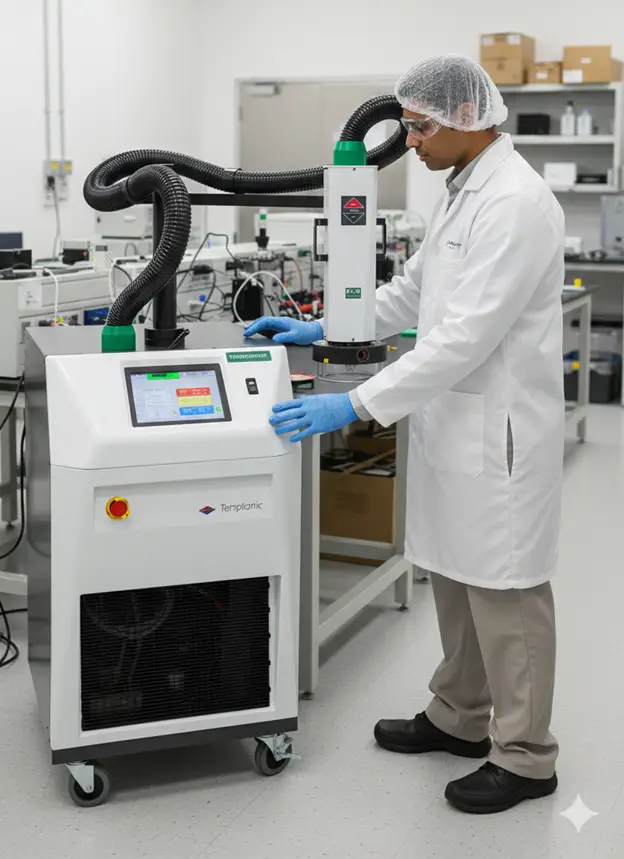
A temperature forcing system (sometimes called a thermal forcing system) is a localized, highly controlled thermal test solution. Instead of heating or cooling an entire chamber, it delivers conditioned air (hot or cold) directly to the device under test (DUT).
Systems such as inTEST Thermal Solutions, available in India through Globetek, are designed for precision, speed, and repeatability.
How temperature forcing works
- Conditioned air (hot or cold) is generated rapidly
- Air is directed through a nozzle onto the DUT
- Temperature changes occur at the device level, not room level
- The system integrates with test handlers, probers, or benches
Key capabilities
- Extremely fast ramp rates
- Wide temperature ranges (often from sub-zero to high positive temperatures)
- Precise temperature control at the device interface
- Compact footprint compared to chambers
Typical Applications
- Semiconductor IC testing
- Wafer probing
- Failure analysis
- Production validation
Temperature forcing answers the question:
“How does this device behave electrically and functionally at specific temperatures — right now?”
Temperature forcing is optimized for speed, precision, and throughput — not long-duration fatigue studies.
Key Differences Between Thermal Cycling and Temperature Forcing
While both methods involve temperature extremes, the way they apply thermal stress — and the type of insight they deliver — is very different.
1. Speed and Responsiveness
Thermal cycling systems take time because they heat or cool the entire chamber mass.
Temperature forcing systems change temperatures in seconds, making them ideal for functional and parametric testing. It often exceeds 50°C per minute — compared to traditional thermal cycling, which follows gradual ramp and dwell profiles.
For semiconductor labs, this speed translates to:
- Higher throughput
- Faster debug cycles
- Reduced test time per unit
2. Temperature Accuracy at the Device
In thermal chambers, the chamber temperature does not always equal the actual device temperature, especially for powered components.
Temperature forcing systems are designed to:
- Deliver air directly to the DUT
- Minimise thermal lag
- Improve correlation between setpoint and device temperature
This is critical for precision testing in IC validation and electronics.
3. Integration with Test Equipment
Thermal cycling systems typically operate as standalone environments. They are better suited for system-level or assembly testing, where multiple components interact.
Temperature forcing is superior for component-level, quick-cycle testing, especially when validating IC performance. Temperature forcing systems are built to integrate with:
- ATE systems
- Semiconductor handlers
- Probe stations
- Bench-level functional test setups
This makes them especially valuable in R&D, validation, and production test flows.
4. Test Objective
| Test Objective | Better Fit |
| Long-term reliability | Thermal Cycling |
| Functional testing at temperature | Temperature Forcing |
| Rapid debug & characterisation | Temperature Forcing |
| Qualification stress testing | Thermal Cycling |
Failure Mode
Thermal cycling typically causes:
- Creep fatigue
- Solder joint shear fatigue
- Long-term material stress
Thermal shock (often enabled by fast temperature forcing systems) can cause:
- Sudden overstress cracks
- Delamination
- Immediate structural failures
The failure mechanisms are fundamentally different.
Summary Table: Thermal Cycling vs Temperature Forcing
| Feature | Thermal Cycling | Temperature Forcing |
| Method | Environmental Chamber | Direct Air Stream |
| Speed | Slower (Ramp/Dwell) | Very Fast (Seconds) |
| Purpose | Long-term reliability / Fatigue | Rapid characterization / Stress |
| Target | Assemblies, Modules | Components, ICs, Wafers |
| Sample Size | High Volume | Small / Individual |
This table alone often clarifies the decision for engineering teams.
When Should You Use Thermal Cycling?
Choose thermal cycling if your goal is:
- Reliability qualification
- Compliance with thermal cycling test standards
- Long-duration fatigue testing
- Evaluating system-level durability
It is especially important in automotive and defense applications.
When Should You Use Temperature Forcing?
Choose temperature forcing if your goal is:
- Functional validation across temperature
- Fast characterization of semiconductor devices
- High-throughput testing
- Failure reproduction under controlled extremes
In production and validation labs, temperature forcing significantly reduces cycle time.
The choice between thermal cycling and temperature forcing depends on what you’re trying to learn from the test.
Ask yourself:
- Do I need long-term stress data or immediate functional behavior?
- Is throughput a bottleneck?
- Do I need tight temperature control at the device level?
- Will this integrate into my existing test flow?
Many advanced labs use both — thermal cycling for qualification and temperature forcing for development, validation, and production testing.
Commonly asked questions:
Answering some additional questions on thermal tests, for your reference:
What Is Thermal Cycling?
In short, it is a test method where products are repeatedly exposed to alternating high and low temperatures to evaluate fatigue and durability over time.
What Is a Thermal Cycling Test Procedure?
A typical thermal cycling test procedure includes:
- Defined upper and lower temperature limits
- Controlled ramp rates
- Dwell time at extremes
- A specified number of cycles
Parameters depend on the product and applicable standards.
What Are Thermal Cycling Test Standards?
Common references include:
- JEDEC standards for semiconductor reliability
- Automotive qualification specifications
- Military standards such as MIL-STD-883 and MIL-STD-810
These standards define temperature ranges, cycle counts, and acceptance criteria.
What Is Thermal Shock Testing?
Thermal shock testing exposes a device to rapid temperature transitions to evaluate resistance to sudden stress. Unlike gradual thermal cycling, thermal shock creates abrupt expansion and contraction forces.
Temperature forcing systems are often used to facilitate thermal shock testing in component-level applications.
The Strategic Approach in 2026
Modern semiconductor, automotive and electronics labs rarely choose one method exclusively.
The smartest strategy is aligning the thermal method with the test objective, not just the available equipment.
- If your goal is long-term reliability and fatigue analysis, thermal cycling is essential.
- If your goal is speed, precision, and functional validation, temperature forcing is superior.
And in 2026, that alignment directly impacts product reliability, time to market, and competitive advantage.
Globetek has been in this field for over 30 years, providing state of the art test equipment to semiconductor and automotive industries. Do write to us, if you need help in charting the next step of testing for your project.


