Published on Jul 01, 2026
Understanding Dielectric Strength Testing vs. Hipot Testing: A Guide for Compliance Engineers
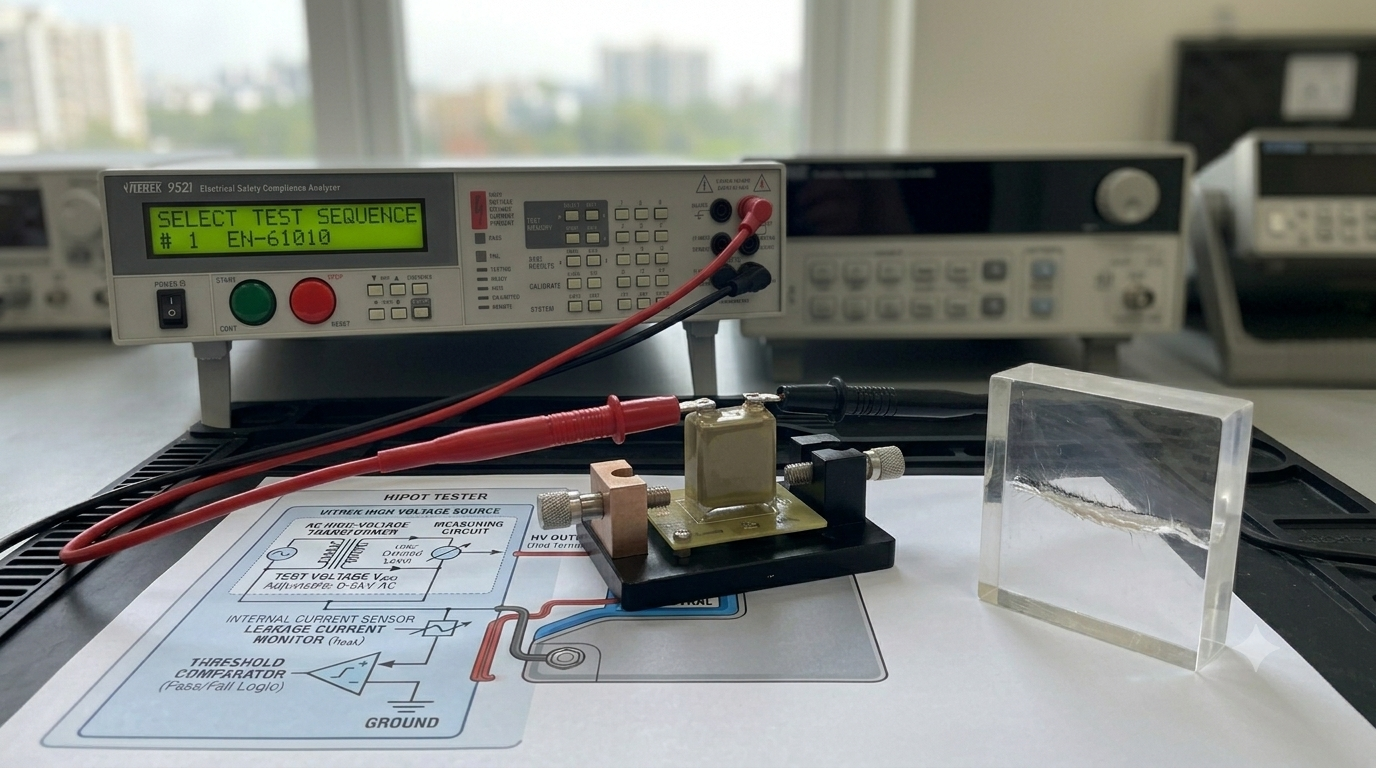
In the world of electrical safety and product certification, compliance engineers and quality assurance teams often find themselves using synonymous terminologies. For example two terms that are frequently used interchangeably and yet cause a fair amount of confusion are Dielectric Strength Testing and Hipot (High Potential) Testing.
If your engineering team is searching for clarity on a “dielectric test” versus a “hipot test”, they are essentially looking at two sides of the same coin. However, understanding the exact nuances, standard requirements, and testing methodologies will ensure product safety, meeting regulatory compliance, and choosing the right test equipment for your facility.
As an authorized partner of Vitrek—a global leader in high-voltage test equipment—Globetek is committed to helping Indian manufacturers and safety engineers streamline their compliance workflows. This comprehensive technical overview will break down the mechanics of dielectric testing, contrast it with standard hipot testing, and guide you toward making an informed decision for your testing laboratory.
What is a Dielectric Strength Test?
At its core, a Dielectric Strength Test evaluates the capability of an electrical insulation system to withstand overvoltage conditions without breaking down. Every insulating material has a limit beyond which it ceases to act as an insulator and begins to conduct electricity. This tipping point is known as the dielectric breakdown.
The test involves applying a voltage significantly higher than the product’s normal operating voltage across the insulation system for a specified duration (typically 60 seconds). The goal is to prove that the insulation can handle transient overvoltages, such as lightning strikes or switching surges, ensuring user safety and equipment longevity.
AC/DC Dielectric Withstand Test vs. AC/DCDielectric Breakdown Test
When configuring your Vitrek equipment on the production line or in an R&D lab, it is important to distinguish between the two primary testing approaches:
- Dielectric Withstand Test (Non-Destructive): This is the standard production-line test. A predetermined voltage (e.g., 2 x Operating Voltage + 1000V ) is applied for a fixed period. If the leakage current remains within acceptable thresholds and no flashover occurs, the product passes. The insulation remains intact, and the product can be shipped to customers.
- Dielectric Breakdown Test (Destructive): Primarily used in R&D or material qualification labs, this test continuously ramps up the voltage until the insulation fails completely and an electrical arc punches through the material. This determines the absolute maximum voltage limit of the material, conforming to international testing standards like IEC 60243.
Circuit Diagram: Typical Dielectric Withstand Test Setup
To visualize how this test is executed safely on a component, consider the following fundamental circuit configuration utilized by modern automated testers:
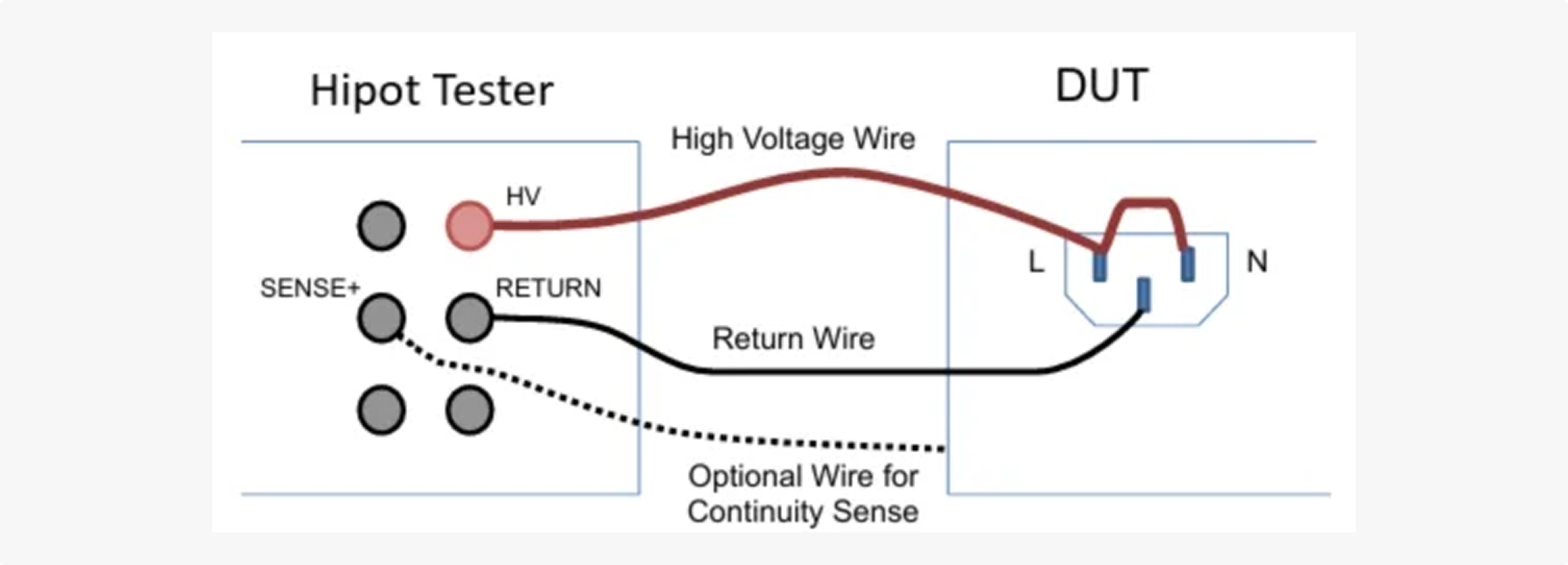
In this setup, the high-voltage output from the tester is applied to the current-carrying conductors (Live/Neutral shorted), while the return side of the circuit is connected to the exposed non-current-carrying metal chassis (Ground). The tester monitors the current flowing through this loop to detect insulation failure.
Dielectric Test vs. Hipot Test: Is There a Difference?
Strictly speaking, they refer to the same fundamental test. “Hipot” is simply an industry shorthand for “High Potential.”
The difference lies primarily in nomenclature and target audience:
- Hipot Test is the term most commonly utilized by production floor operators, production managers, and general electrical technicians.
- Dielectric Strength Test (or Dielectric Withstand) is the terminology formalised in international design standards (such as IEC 60664 and IEC 60243) and is favored by safety engineers, compliance auditors, and design laboratories.
Quick Comparison Reference
| Parameter | Dielectric Strength Test | Hipot (High Potential) Test |
| Primary Context | R&D, Material Characterization, Certification | Production Line Testing, Routine Safety Checks |
| Test Nature | Can be destructive (Breakdown) or non-destructive (Withstand) | Almost exclusively non-destructive (Withstand) |
| Standards Cited | IEC 60243, IEC 60664, ASTM D149 | UL 60950, IEC 60335, local regulatory norms |
| Typical Voltages | Variables based on material thickness (kV/mm) | Fixed formulas (e.g., 1000V + 2 x Vnormal ) |
| Key Output | Exact material breakdown point or passing threshold | Binary Pass/Fail based on leakage current limit |
Compliance Standards & Typical Test Voltages
When engineering products for global markets, compliance with international standards is non-negotiable.
- IEC 60243: Governs the electrical dielectric strength of solid insulating materials at power frequencies.
- IEC 60664: Details insulation coordination for equipment within low-voltage systems, determining clearance and creepage distances alongside dielectric test voltage requirements.
For most commercial appliances operating at 230V AC, a typical test voltage of 1500V to 2500V AC is applied. For industrial equipment, medical devices, or solar inverters, these test voltages can scale significantly higher.
Understanding “Pass/Fail”
- Pass: The material successfully withstands the applied voltage without experiencing an insulation breakdown or exceeding the maximum pre-set leakage current threshold (usually measured in milliamperes).
- Fail: A sudden spike in leakage current or a visual/audible electrical arc indicates that the insulation has been compromised.
Choosing the Right Tester for Your Operations
To make an accurate decision for your facility, you need an instrument that combines precision measurement with uncompromising operator safety. Through Globetek, you have direct access to.
Vitrek’s industry-leading product portfolio
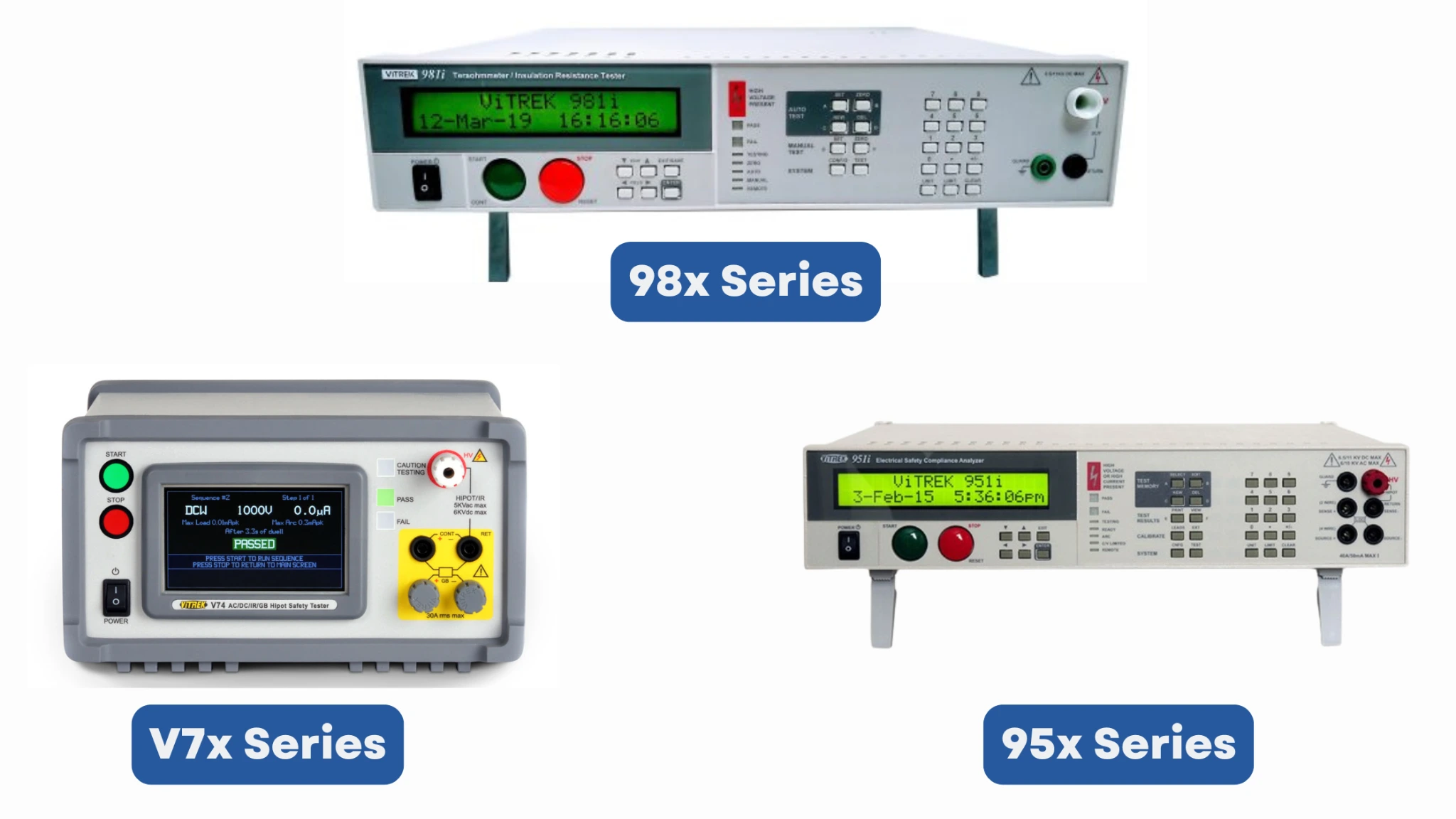
- For automated high-volume production lines requiring ultra-fast, multi-channel testing, the Vitrek V7X Series Hipot Tester offers versatile AC/DC hipot testing with built-in leakage current resolution down to 0.1 microamps.
- For complex laboratory environments demanding exceptionally high voltage limits and advanced analysis, the Vitrek 95X Series provides up to 10 kV AC and 11 kV DC capability, allowing your engineers to perform both non-destructive withstand testing and precise destructive breakdown testing.
Explore the full technical specifications on our dedicated Vitrek Hipot Tester Product Page to find the ideal unit for your compliance needs.
Frequently Asked Questions (FAQs)
Can an AC dielectric test be substituted with a DC hipot test?
Yes, many standards allow the substitution of an AC test voltage with a DC voltage, provided the DC voltage is multiplied by the peak factor (√2, or roughly 1.414 times the AC value). For instance, a 1500 V AC test would require approximately 2121 V DC. However, always verify your specific product standard, as AC testing stresses the insulation differently than DC.
What causes a product to fail a dielectric strength test?
Failures are typically caused by mechanical defects, manufacturing flaws (such as pinched wires or insufficient spacing), contamination (dust or moisture on insulating surfaces), or inherently flawed raw materials that cannot handle the electrical stress specified by standards like IEC 60664.
How often should our dielectric testing equipment be calibrated?
To maintain compliance with BIS, ISO standards and international safety auditors, dielectric and hipot testers should be calibrated at least once every 12 months. Globetek provides comprehensive local support and calibration services across India to keep your Vitrek equipment performing accurately.
Partner with Globetek for Your Compliance Needs
Selecting the proper test parameters and equipment ensures your products hit the market without regulatory delays. For detailed product consulting or a tailored quotation on the Vitrek testing lineup, visit our Hipot Tester Page or reply directly to this email to speak with our application engineering team.
Read More