Published on Jun 04, 2026
Leakage Current Tester: What It Is and How It Differs from Hipot Testing
Let’s answer the question right away:
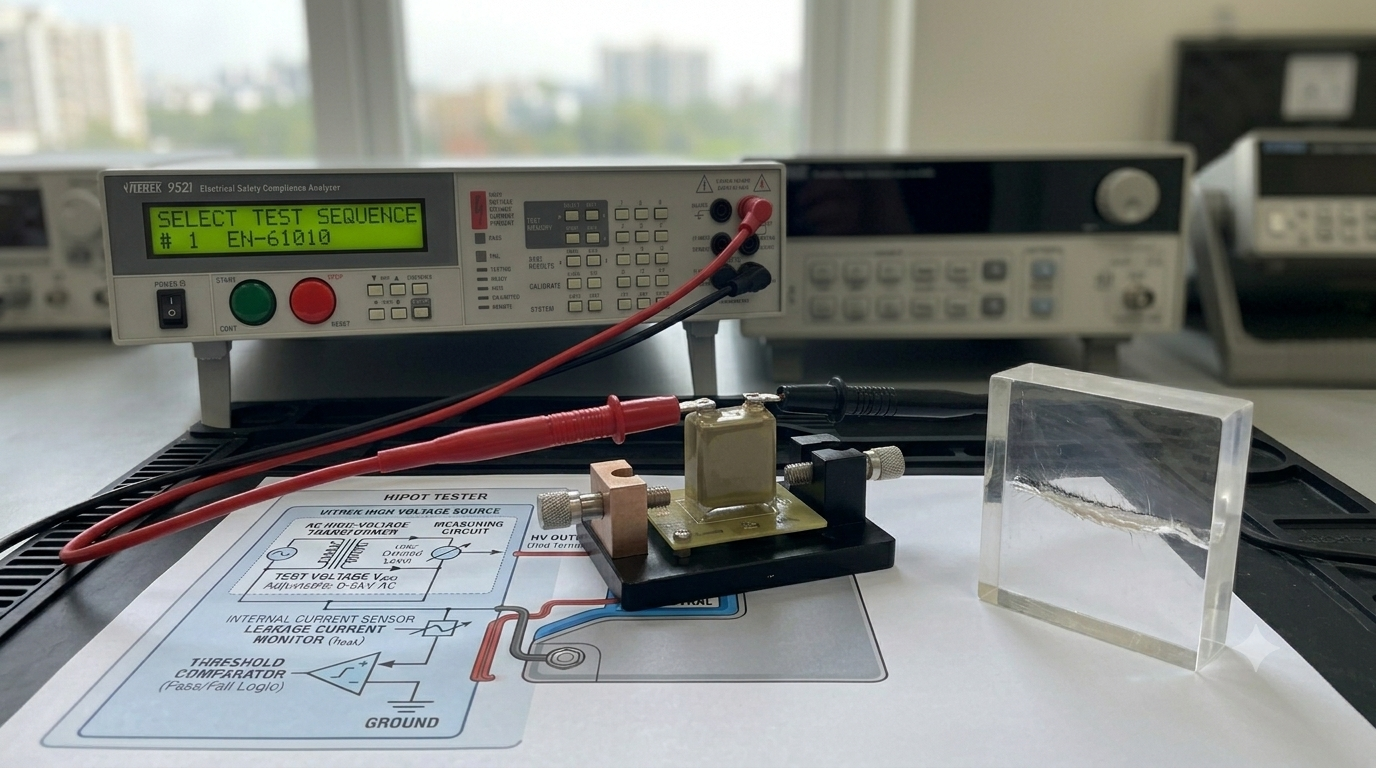
A hipot tester asks: “Will the insulation survive an overvoltage stress test without breaking down?”
A leakage current tester asks: “Under normal operating voltage, how much current finds its way to places it should not be, like a user’s hand?”
Conflating them is a compliance mistake that shows up in audit reports more often than one imagines.
Using a hipot tester’s leakage readout as a substitute for a proper leakage current measurement is like checking your tyre pressure with a nail gun. It will tell you something, but not the right thing. Hipot leakage is measured at overvoltage through potentially compromised insulation; touch current is measured at rated voltage through an intact, operating product. The numbers are not comparable, and a certification body will not pretend otherwise.
What Is a Leakage Current Tester?

A leakage current tester (also called a touch current tester or earth leakage tester) measures the small amount of current that flows from a live part to earth, or to an accessible conductive surface, through or across the insulation of a product operating at its rated voltage.
Unlike a dielectric breakdown test you are not stressing the insulation. You are observing what the insulation normally leaks under everyday conditions, and comparing it against safe limits defined by IEC 60990, IEC 60601-1, or the relevant product standard.
As human beings, we respond to current, not voltage. A few milliamps through the wrong path can cause involuntary muscle contraction, ventricular fibrillation, or burns. Leakage current testing is how you prove that the current reaching any touchable surface stays below those biological thresholds.
Types of Leakage Current
| Type | Where you’ll see it | Path | Relevant Standard | Typical Limit |
| Earth Leakage | Industrial equipment, IT gear, appliances | Live parts to protective earth conductor | IEC 60990, IEC 62368-1 | 3.5 mA (IT eq.), 0.5 mA (consumer) |
| Touch Current | Consumer electronics, household appliances | Accessible surface to reference earth (via body network) | IEC 60990, IEC 62368-1 | 0.5 mA (Class I), 0.25 mA (Class II) |
| Patient Leakage | Medical devices with direct patient contact | Applied part to earth (patient body in circuit) | IEC 60601-1 | 10 µA (CF type), 50 µA (BF type) |
| Ground Leakage | Medical, EV chargers, industrial | Earth pin to enclosure; tests PE continuity + leakage | UL 60601, IEC 60601-1 | 300 µA (CF), 500 µA (BF) |
Basic Leakage Current Measurement Circuit
The fundamental test circuit places a standardised human-body impedance network (defined in IEC 60990 Figure 4) between the accessible part under test and the reference point, then measures the resulting current:
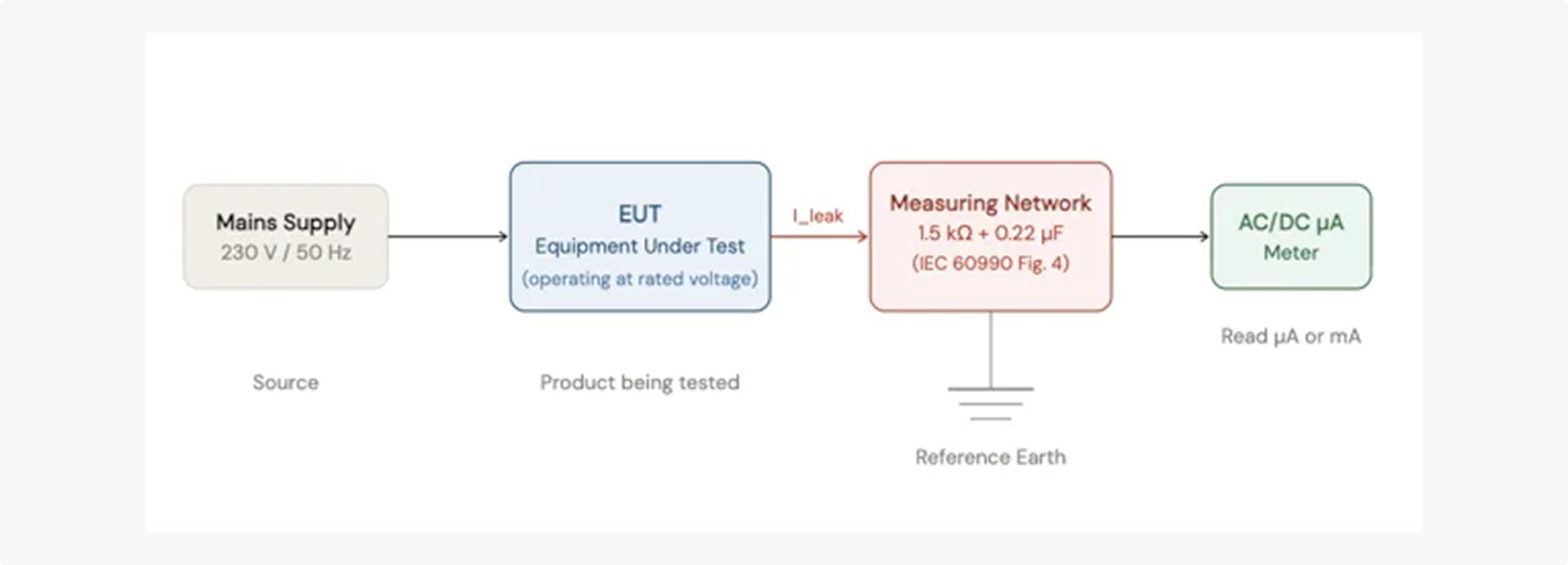
Fig. 1 — Simplified leakage current test circuit per IEC 60990. The measuring network simulates human body impedance. The meter reads the current that leaks to the reference earth through the network.
How To Perform Leakage Current Testing using a Hipot tester
Can a hipot tester measure leakage current? The short answer is – not all of them.
Only Vitrek’s hipot testers have the unique ability to detect leakage currents – at even pico amp levels. Let’s talk about the test setup, the procedure and the choice of AC vs DC.
Test Setup:
Here, a high-voltage source, typically from the Hipot tester, is applied to the device under test (DUT). The current is then monitored as it leaks through the insulation, with a return path completing the circuit.
Test Procedure:
The voltage is usually ramped up slowly to the desired test level, and the tester records the current that leaks through. A dwell time at the maximum test voltage may be applied to assess stability. Throughout the test, the current is monitored for any irregularities.
AC vs. DC Testing:
Depending on the application, leakage current tests can be done with alternating current (AC) or direct current (DC). AC is commonly used for standard electronics, while DC testing may be more suitable for devices like power supplies or medical equipment.
Industry standards and acceptable Leakage Current Limits
Here’s a fact: Some leakage is inevitable in every real product. EMC filters, Y-capacitors, and cable capacitance all contribute. The test determines whether the sum total crosses a threshold that standards consider dangerous. One should know that zero leakage exists only in theory and in marketing materials.
Various safety regulations define acceptable leakage current levels based on the equipment type and usage. Some key standards include:
- IEC 61010: For electrical equipment used in laboratories and industrial settings.
- IEC 60601: For medical electrical equipment.
- UL 60950: For IT equipment.
Each standard outlines specific limits on leakage current, depending on the device’s function and environment.
| Application | Typical Limit |
| Consumer Electronics | < 0.5 mA |
| Medical Devices (Type B) | < 100 µA |
| Industrial Equipment | < 3.5 mA |
| High Voltage Systems | Custom limits based on use case |
How Vitrek’s Hipot Testers Enhance Leakage Current Testing
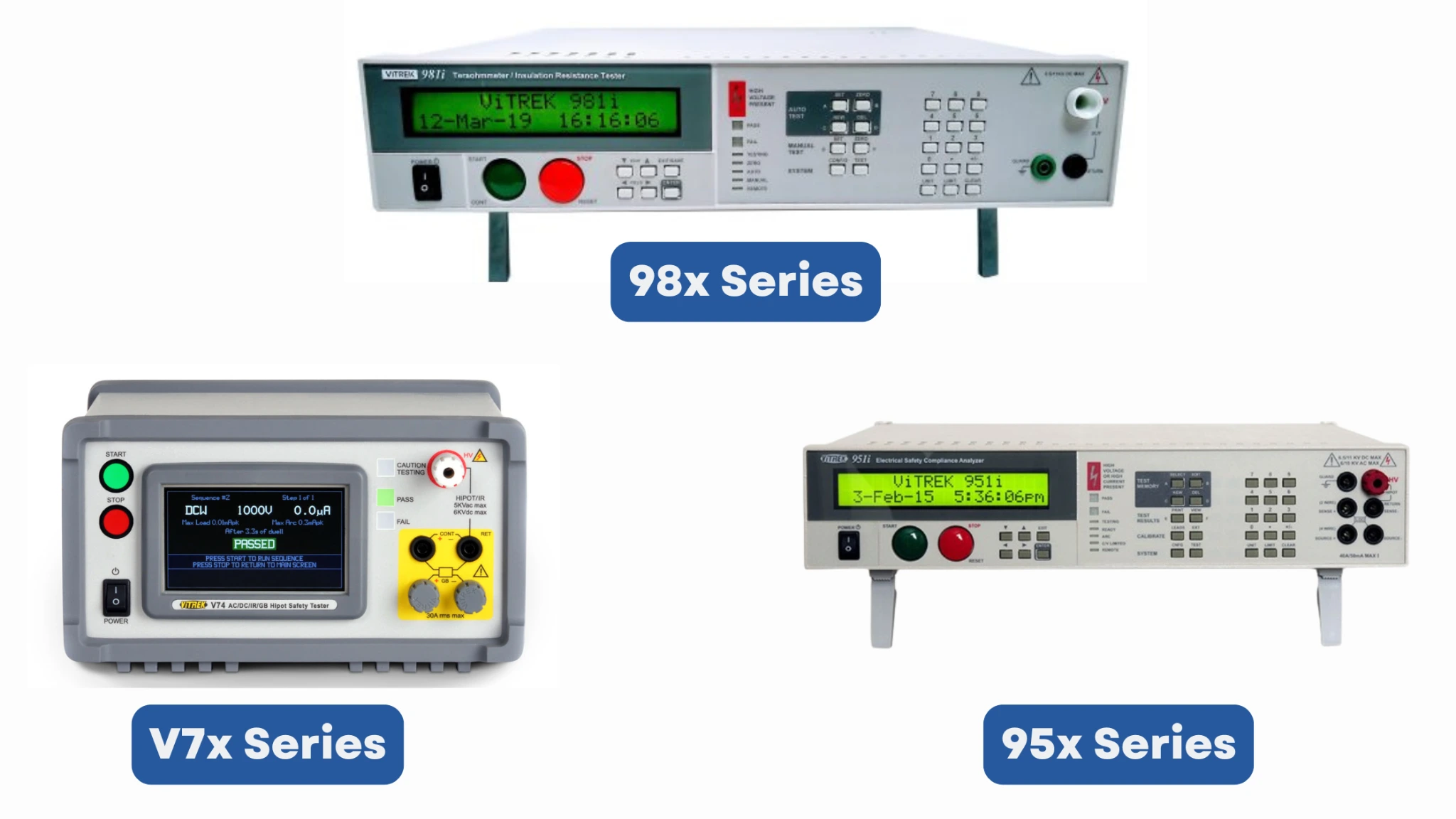
Vitrek’s electrical safety analyzers platforms handle both hipot and leakage current testing from a single instrument, which matters in production environments where test cycle time is a real cost. They do not make you choose between thoroughness and efficiency, which is a pleasant change from most engineering trade-offs.
Vitrek 95X Series
R&D / Lab / High-Voltage
- Leakage resolution: 100 pA
- AC hipot up to 10 kV (30 kV with AC-30 option)
- Phase angle measurement (resistive vs capacitive leakage)
- Dual DSP, ramp rates up to 50 kV/s
- Ground bond up to 40 A RMS
- Ethernet, RS232, USB, GPIB interfaces
Vitrek V7X Series
Production / Cost-Effective
- Leakage measurement to 100 nA
- AC/DC hipot to 5 kV
- Insulation resistance to 450 GΩ
- Ground bond to 30 A
- V76 model: 24-channel built-in HV switching
- 2-year warranty; Made in USA
Vitrek V10X Series
Newest Platform
- Up to 30 kV output
- 100 pA leakage resolution
- Integrated ground bond + low-ohms
- TLSS™ auto test lead safety verification
- Up to 256 test points via 964i Scanner
- Built for Industry 4.0 workflow
Globetek has been Vitrek’s partner in India for over 30 years, bringing in state of the art devices for precise measurement needs across different industries.
At Globetek, our team can tell you which model firmware version handles a specific IEC 60601-1 single-fault scenario without putting you on hold, that’s because our engineers have hands-on experience with IEC 60601-1 medical, IEC 62368-1 IT/AV, and EV charger test setups. We help you configure the test sequence if needed, and not just hand over the box.
FAQs
What are the best practices for Safe Leakage Current Testing?
You can follow a few:
● Always ground your DUT properly and verify test connections.
● Allow for capacitive discharge time, especially during AC tests.
● Use testers with built-in filtering and averaging to reduce noise.
● Regularly calibrate and validate your equipment to maintain measurement integrity.
Up to what resolution can Vitrek’s hipot testers catch leakage current?
These Hipot testers can measure leakage current down to picoamp levels, essential for medical and aerospace applications.
What’s the maximum test voltage?
Specific to Vitrek models,
● The V7x applies voltage of up to 5kV in both AC and DC modes.
● Whereas 95x and V10x apply up to 30kC AC and 15kV DC.
What’s the maximum range of leakage current the instrument can measure?
Different models have different ranges of measurement. It goes from 20mA all the way till 200mA across different product ranges.
Which standards do Hipot testers from Vitrek comply with?
Vitrek complies with BIS, IEC, CE and UL and CSA standards.
Read More